Zero-Emission Conversion
Advanced thermochemical decomposition designed to avoid harmful dioxin and particulate emissions. Actual performance depends on feedstock, controls and operating conditions.


Tackling Cambodia’s municipal solid waste, surging plastics, and agricultural burning by converting carbon-containing waste into valuable GreenSynGas™, electricity, and mineral fertilizer through modular, net carbon-neutral technology.
Driven by rapid urbanization, industrial growth, and shifting agricultural practices, traditional disposal methods are reaching a critical tipping point.
Feedstock
Cambodia’s rice, cassava, sugarcane, cashew, rubber and coconut sectors, together with organic-rich city waste, offer a broad resource base. The figures below are indicative estimates for Cambodian waste types only, not measured results.
| Feedstock | Typical moisture | Indicative GreenSynGas™ yield (Nm³/t) |
|---|---|---|
| Rice straw (wet & dry season harvests) | 15–30% | 1,100–1,700 |
| Rice husks (rice mills) | 10–15% | 1,300–1,900 |
| Cassava stems & peels | 50–70% | 650–1,200 |
| Sugarcane bagasse | 45–55% | 900–1,400 |
| Maize stalks & cobs | 15–30% | 1,200–1,700 |
| Cashew nut shells | 8–12% | 1,600–2,300 |
| Rubber wood & plantation residues | 25–40% | 1,100–1,600 |
| Coconut husks & shells | 10–20% | 1,200–1,700 |
| Municipal solid waste (organic-rich, Phnom Penh) | 45–60% | 900–1,400 |
| Plastics waste | 5–15% | 1,800–2,800 |
| Used cooking oil / FOG | <10% | 2,500–4,200 |
Indicative only. Yields are normal cubic metres of gas per tonne of feedstock received, not tonnes of gas. Moisture ranges reflect Cambodia’s tropical climate and harvest seasons; actual results depend on moisture, ash, carbon content, particle size and operating conditions, and every feedstock needs project testing.
Patented, innovative modular technology transforming Cambodian municipal waste, plastics, and agricultural biomass into a valuable circular resource.
Comprehensive Input
Plastics, agricultural residues (rice straw, cassava stems), municipal solid waste, and industrial biomass — anything carbonaceous.
Separation & Shredding
Metals, glass, and inert materials are removed. The remaining organic and plastic fractions are shredded and prepped.
Steam Reforming
Hydrocarbons react with steam at 700–1000°C using flameless burners, producing clean syngas without toxic emissions.
GreenSynGas™ & Fertilizer
Outputs GreenSynGas™, hydrogen, mineral fertilizer, and distilled water. Part of the output self-sustains the reformer unit.
The Blue Systems Cure
Instead of open burning or landfilling, Blue Systems proposes high-temperature steam reforming modules at agricultural clusters and city waste hubs across Cambodia. Farming residues and municipal waste become GreenSynGas™, with an illustrative potential energy value of US$400 per processed tonne.
Advanced thermochemical decomposition designed to avoid harmful dioxin and particulate emissions. Actual performance depends on feedstock, controls and operating conditions.
Modular units installed near agricultural clusters and city waste hubs can reduce costly, polluting long-distance hauling.
GreenSynGas™ can supply power generation, hydrogen production or green chemical synthesis, subject to project design and offtake agreements.
Municipal & agricultural waste
Potential GreenSynGas™ Value
US$4,000
Estimated CO₂ Prevented
18.5 Tonnes
Illustrative estimates based on US$400 per processed tonne of dry agricultural waste and 1.85 tonnes of avoided CO₂ per tonne. Actual yields, energy value, and emissions reductions depend on feedstock and project conditions; these are not guaranteed returns.
From rural farmer cooperatives managing agricultural straw to major municipal clusters handling Phnom Penh's urban waste streams.
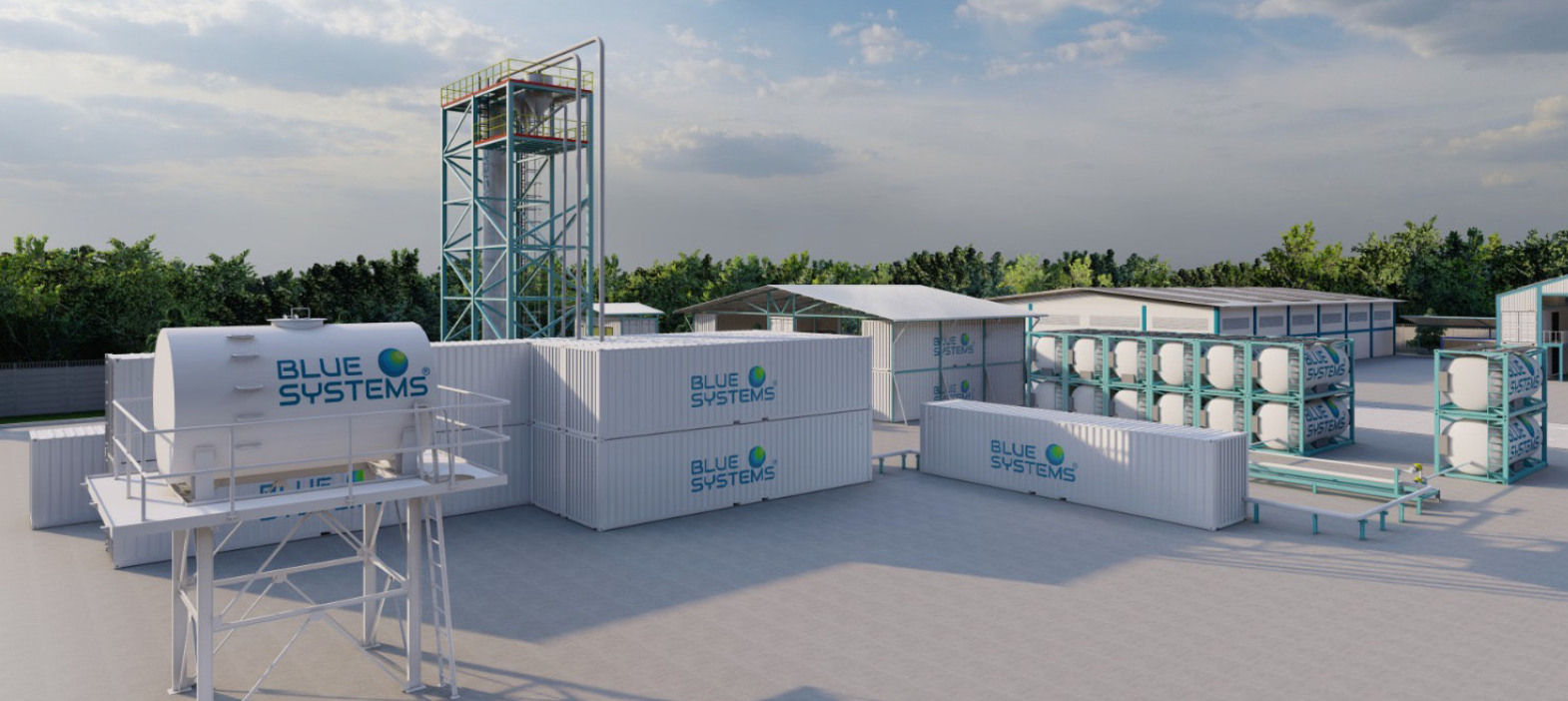
Blue Systems® MkII modular plant — artist's impression
A modular, single-container unit designed to process agricultural residues (rice straw, cassava stems) and rural plastics into green syngas and fertilizer.
Processes municipal solid waste daily for provincial cities and industrial zones. Perfect leasing option for local authorities under Sub-Decree No. 113.
Multiple units combined to process large-scale MSW and divert waste away from overloaded dumpsites like Dangkor Landfill.
Products
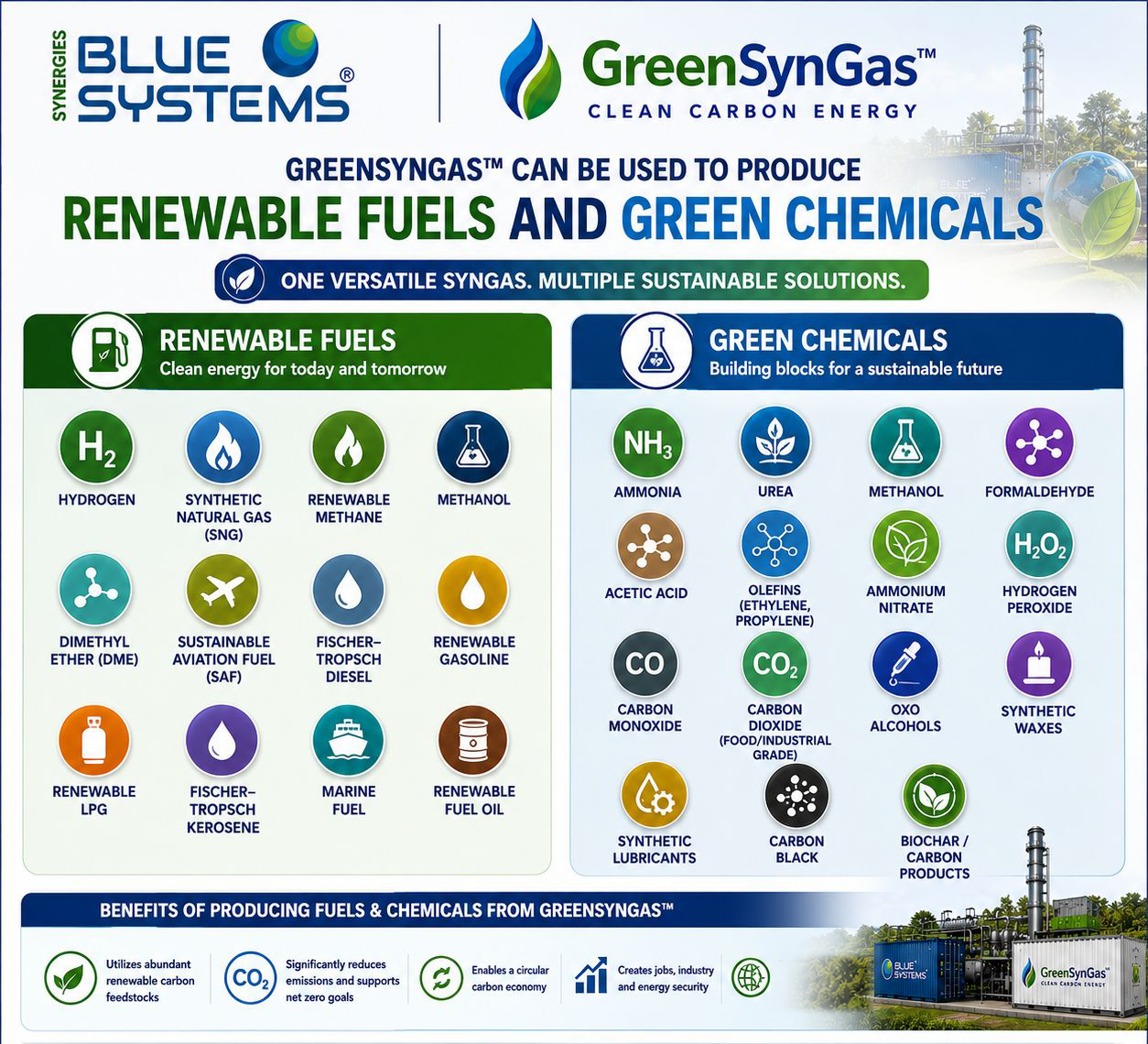
Renewable fuels include hydrogen, synthetic natural gas, methane, methanol, dimethyl ether, sustainable aviation fuel, diesel, gasoline, LPG, kerosene, marine fuel and fuel oil.
Green chemical pathways include ammonia, urea, methanol, formaldehyde, acetic acid, olefins, ammonium nitrate, hydrogen peroxide, carbon monoxide, carbon dioxide, oxo alcohols, synthetic waxes and lubricants, carbon black and biochar.
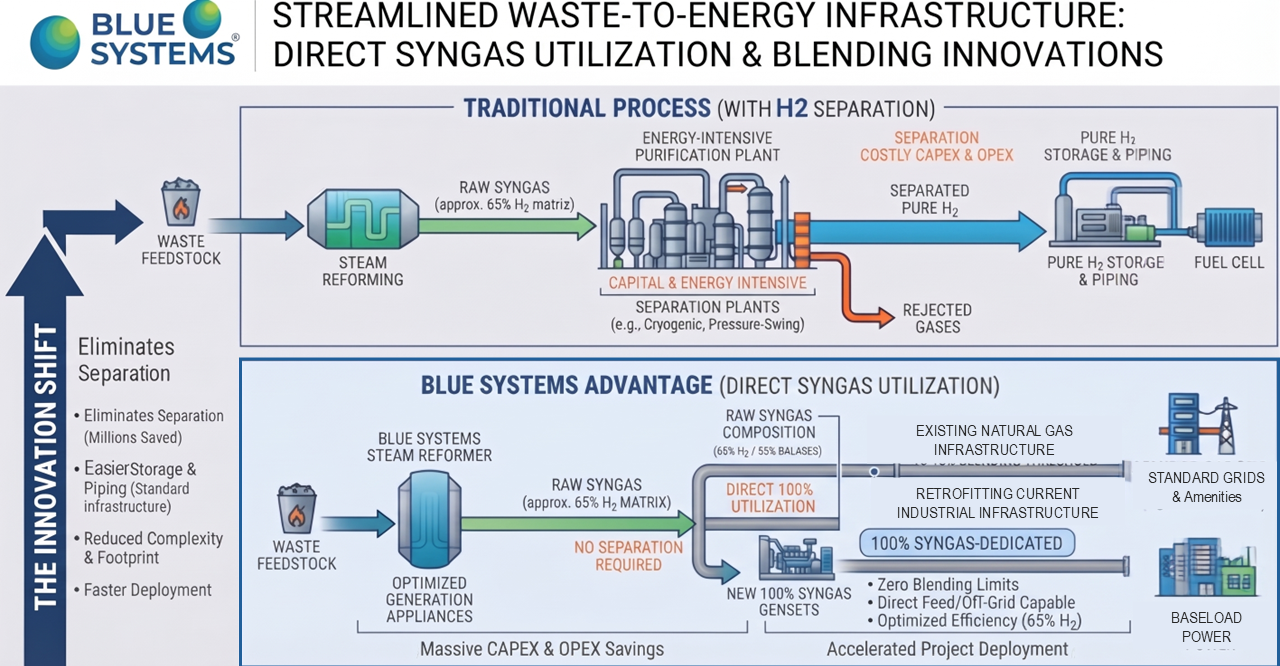
Hydrogen-rich GreenSynGas™ can be used directly in compatible generation equipment rather than always separating pure hydrogen first. Recent combustion engineering can reduce the need for energy-intensive purification, lowering capital expenditure and operating complexity where the application permits.
The reference gas matrix is approximately 65% hydrogen-rich composition; actual composition varies with feedstock and operation. Direct use and blending must be validated for each installation.
The reference approach describes synthetic gas blended with natural gas in compatible engines and industrial generator sets, including European examples such as the Netherlands. Blends of 10–50% are an indicative reference, not an approved specification for every Cambodia project; appliance compatibility, gas quality and local requirements must be assessed.
Replacing part of fossil natural gas with renewable GreenSynGas™ can lower reliance on natural gas reserves and support local carbon-reduction goals.
Compatible commercial generator sets and turbines can use blended fuel for data-center backup or primary power, subject to manufacturer approval and any necessary modifications.
Direct gas utilization can support reliable power for mission-critical facilities such as data centers, with appropriate system design, fuel supply and backup arrangements.
Readily available second-hand generator sets offer a potential low-capital-cost route to power generation. The reference page indicates 2.5–3 MW+ for every 50 tonnes of waste recycled per day; output is project-dependent and not guaranteed.
Where direct syngas use is suitable, removing dedicated hydrogen-separation infrastructure can reduce upfront capital costs and operational complexity for municipal and industrial developers.
Pure hydrogen requires specialist materials and storage to manage leakage and embrittlement. Unseparated syngas may simplify the system, but still requires engineered gas-safe piping, storage and controls.
Simplified supporting infrastructure can shorten the path from municipal and agricultural feedstock intake to operational power generation.
Job Creation
Local workers collect, organize and sort municipal waste alongside agricultural residues. At scale, this has the potential to support thousands of jobs, turning discarded material into an income-generating supply chain.
Skilled Cambodian engineers, technicians and operational staff run steam reforming plants processing municipal and agricultural streams, fostering local technical expertise and high-value green-energy careers.
Regional ethanol and methane distribution, transport logistics, safety compliance and commercial management can create new local industries. Domestic use of these downstream products can reduce dependence on expensive imported energy; employment and energy outcomes depend on project scale and markets.
Containerized control room with remote monitoring and internet-enabled diagnostics.
Prefabricated modular units ensure rapid on-site assembly and shorter project timelines.
Advanced flameless burners eliminate toxic incineration emissions and landfill methane.
Stops crop residue and agricultural plastic burning, dramatically improving rural air quality.
Turns waste disposal costs into revenue streams via green energy, distilled water, and mineral fertilizer.
Engineered to strict ISO standards with independent third-party inspection (DNV/TÜV).
Partner with us to deploy modular waste-to-energy and hydrogen solutions across municipalities, industrial zones, and agricultural cooperatives in Cambodia.